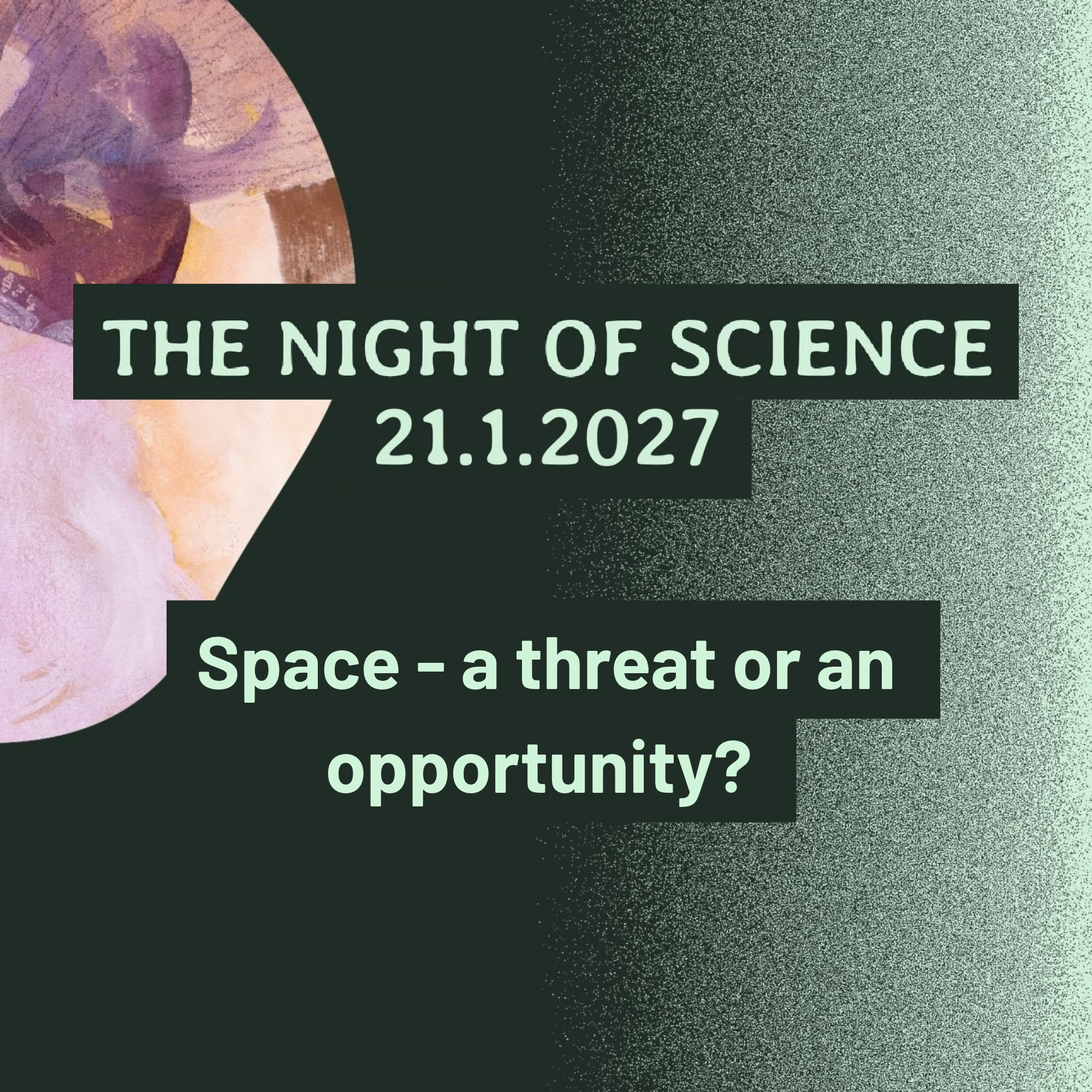
Night of Science: Space environment near earth – a threat or an opportunity?
Can people survive in space for long periods of time? What problems and possibilities do satellite mega-constellations present? How can we protect the Earth from potentially dangerous asteroids?
What? Open lectures and panel discussion
Where? At Messukeskus, room 101AB, Rautatieläisenkatu 3, Helsinki. Also remotely through Pori Space Lab website.
When? On the Night of Science, 21.1.2027 17.00–19.00
During the event, you will learn about the space environment and the threats and opportunities related to it from the perspectives or people, technology, and the future of our planet’s future. There will be public lectures, panel discussion, and Finnish space technology on display. The first lecture of the evening will be held in english and the other two will be in finnish. Panel discussion will be in both finnish and english. You can also participate on the event remotely through Pori Space Lab channels. A link for remote access will be published later on this page.
Programme:
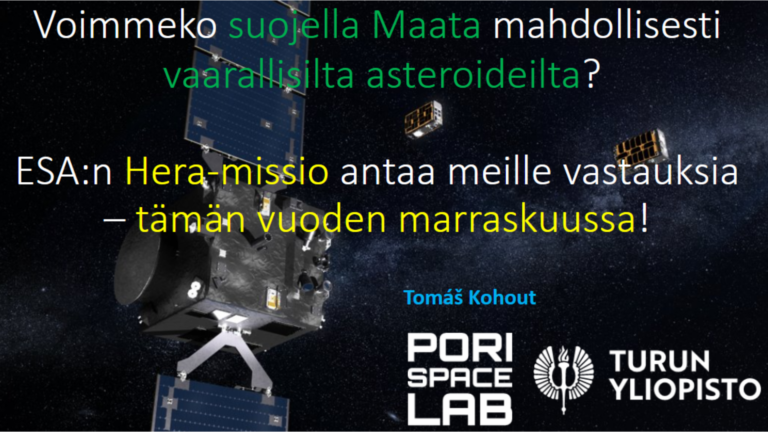
Klo 17.00–17.30 Tomáš Kohout (University of Turku): How can we deflect a hazardous asteroid?
Asteroid impacts are one of the most common geological processes shaping planetary surfaces in our Solar System. On Earth, large asteroid impacts in the distant past have been linked to global climate change and mass extinctions. While an impact capable of causing destruction on a global scale is not expected in the near future, many smaller asteroids in the vicinity of Earth have yet to be discovered. Impacts from such asteroids could cause damage on a regional scale.
Could we deflect a hazardous asteroid before it hits Earth? Hera is an ESA planetary defence mission that arrived at the binary asteroid system Didymos in November 2026 to study the effects of an asteroid deflection experiment. We will discuss the latest observations from Hera and what they can tell us about asteroid deflection.
Klo 17.30–18.00 Rami Vainio (University of Turku): Is long-term sustainable human presence in space feasible?
Space as an environment is very different from what our species evolved in. Thus, our bodies are adapted to certain gravity, atmospheric pressure and composition, and suffer when being exposed to ionising radiation. In space, people have to survive in sometimes extreme conditions. Characterising and predicting the state of space environment and its direct and indirect effects on biological systems in space are topics of active research. Thus, it warrants the question, is long-term sustainable human presence in space feasible? If so, what type of systems it needs to support life and well-being?
Klo 18.00–18.30 Jaan Praks (Aalto university): Who Owns the Sky? The Rise of Satellite Mega-Constellations
Tens or even hundreds of thousands of satellites may soon orbit Earth, creating a new global infrastructure for communications, navigation and observing our planet. But can space sustain this growth? Mega-constellations bring enormous opportunities and possibilities to solve global challenges—and new problems from space debris, pollution, radio-spectrum congestion and many other aspects.
Klo 18.30–19.00 Panel discussion; Space – a threat or an opportunity?
Tomáš Kohout, Rami Vainio and Jaan Praks talk about the problems and possibilities related to near-Earth space. Panel discussion in finnish and in english.
Arrival and accessibility
Arrival instructions at Messukeskus website. Room 101AB is on the first floor. Easiest access to the event is through the doors on the right side of the Holiday Inn -hotel’s doors. The area is accessible, and includes accessible bathrooms.
Event info at Night of science programme website
More information about the event:
Ella Toppari (contact person for the event), +358 50 4786660, info(at)porispacelab.fi.